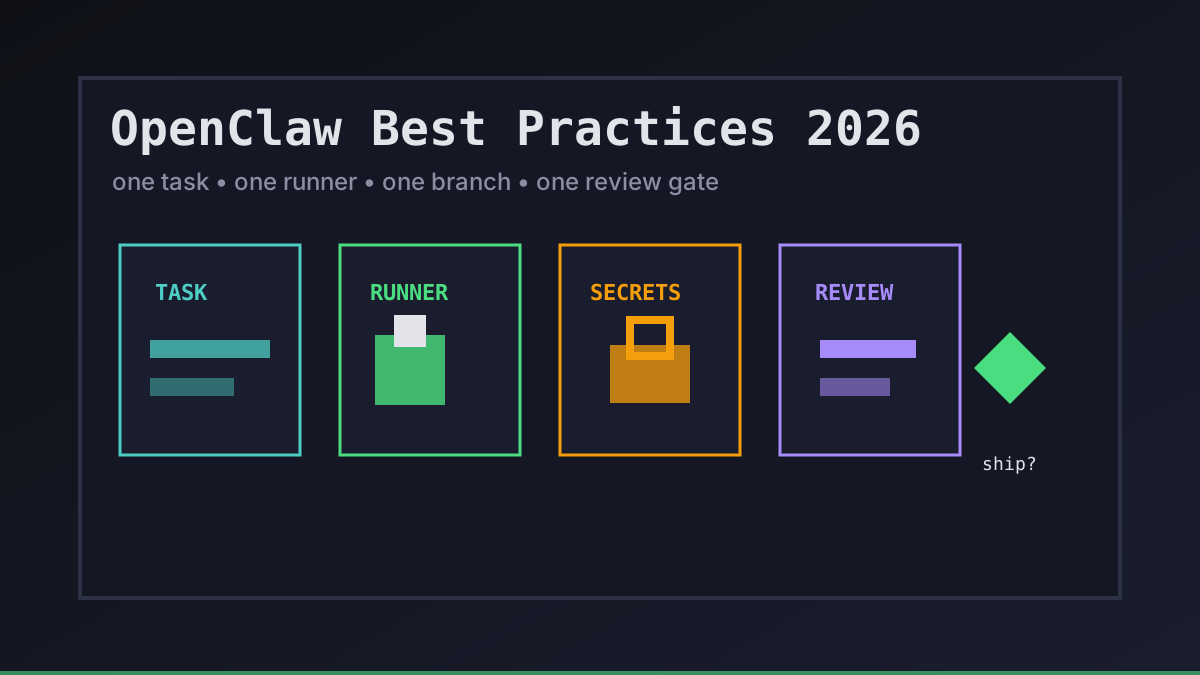
OpenClaw changed how developers think about autonomous coding work, but 2026 is the year teams need operating discipline. The teams getting value are not simply launching more agents. They are giving every agent a narrow job, a safe runner, a reviewable branch, and a clear stop condition.
Office Claws is not a native OpenClaw runtime. We use the same operating model for OpenClaw-style workflows and Codex-backed agents: desktop control, local key handling, VPS runners, visible logs, and human merge gates. If you are comparing runtimes first, start with OpenClaw vs Codex, then use this checklist as the day-to-day runbook.
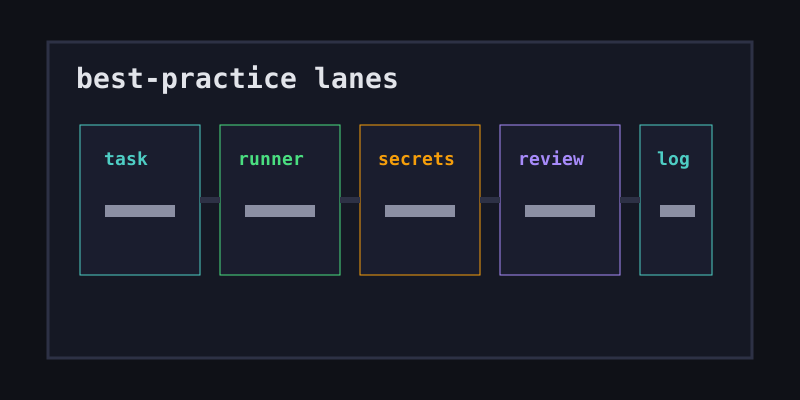
OpenClaw Best Practices Start With Smaller Tasks
The safest OpenClaw task is boringly specific. Instead of asking an agent to "improve billing," give it one repo, one branch, one success condition, and one owner who can answer questions.
| Practice | Good default | Risk it reduces |
|---|---|---|
| One task, one branch | agent/fix-pricing-copy | mixed diffs and unclear ownership |
| One runner per task | local worktree or small VPS | cross-task contamination |
| Narrow allowed paths | website/content/** | accidental product or infra edits |
| Explicit exit gate | npm run build or go test ./... | summaries without evidence |
| Time and token budget | 30-60 minute checkpoint | runaway loops and surprise cost |
This is where Office Claws for OpenClaw users helps most: the desktop becomes the visible queue and the VPS becomes an isolated execution lane, rather than a pile of forgotten terminal panes.
Isolate Runners Before You Scale
Do not scale OpenClaw-style work by sharing one giant checkout. Scale by cloning the repo into separate workdirs, giving each agent its own branch, and treating remote machines as disposable. If an agent gets stuck or drifts, you should be able to stop the runner without losing another task.
task:
  owner: engineering-oncall
  branch: agent/payment-copy-audit
  runner: vps-small-04
  allowed_paths:
    - website/content/blog/**
    - website/src/app/**
  gates:
    - npx velite build
    - npm run build
For remote execution details, see OpenClaw remote runner architecture and OpenClaw sandbox. The important rule is simple: every autonomous task gets a blast radius you can explain.
Treat Secrets as a Product Boundary
OpenClaw best practices in 2026 should assume that agents can run powerful commands. That does not mean every agent should receive production tokens, deployment keys, or broad .env files. Keep secrets local when possible, scope tokens when remote access is required, and separate build credentials from deployment credentials.
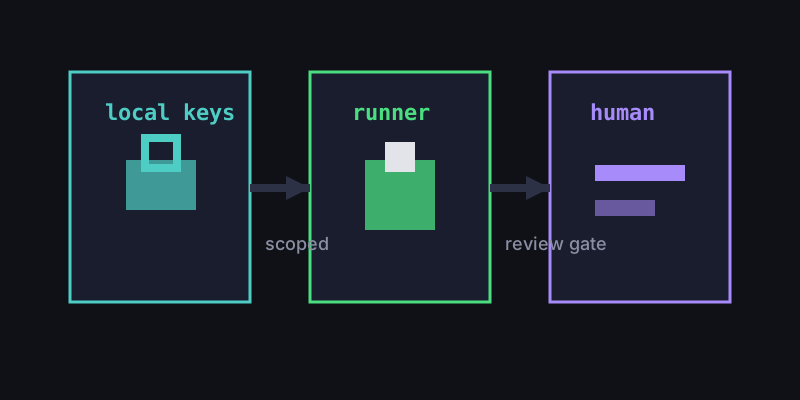
Use this default policy:
- No production deploy keys inside ordinary coding runners.
- Read-only tokens for investigation tasks.
- Short-lived or scoped credentials for remote work.
- Human approval for deploys, billing changes, and data deletion.
- Logs that show which command used which boundary.
The deeper checklist lives in OpenClaw security best practices and OpenClaw secrets management. Office Claws reinforces the same boundary by keeping the operator view local while runners do the narrow work.
Monitor Cost, Loops, and Review Quality
A good OpenClaw workflow is observable. We want to know when an agent is making progress, when it is repeating itself, and when it is spending budget on a weak plan. Monitoring is not only uptime; it is task health.
| Signal | What to watch | When to intervene |
|---|---|---|
| Git diff | files touched and diff size | unrelated directories changed |
| Command log | repeated failures | same error after two attempts |
| Budget | elapsed time and tokens | checkpoint exceeded |
| Validation | tests, builds, linters | skipped gate or unexplained failure |
| Review notes | risks and assumptions | vague summary or no rollback plan |
Pair OpenClaw monitoring with a GitHub review flow. Agents can prepare branches and evidence, but humans should still own product tradeoffs, security exceptions, and the final merge.
Recommended 2026 Operating Checklist
Use this as the default Office Claws runbook for OpenClaw-style work:
- Write a task contract before the agent starts.
- Create one branch and one isolated runner per task.
- Keep production secrets out of coding runners.
- Stream logs and watch for loops or scope drift.
- Require a concrete validation command before completion.
- Review the diff, not just the agent summary.
- Merge manually or through a normal PR gate.
- Archive the outcome so future agents can learn from the pattern.
That is the practical promise of Office Claws: not replacing judgment, and not claiming to be OpenClaw itself, but making autonomous coding work easier to operate. You get desktop management, VPS runner provisioning and monitoring, Codex-backed execution when that is the practical path, safer local key handling, and review gates that keep humans in charge.
Related Reading
- OpenClaw vs Codex — compare runtime and operations tradeoffs.
- Office Claws for OpenClaw users — desktop management for agent work.
- OpenClaw security best practices — credentials, approvals, and runner isolation.
- OpenClaw background tasks — durable async work without hidden panes.